How Do You Take a Picture of a Black Hole? | PODCAST: The Joy of Why
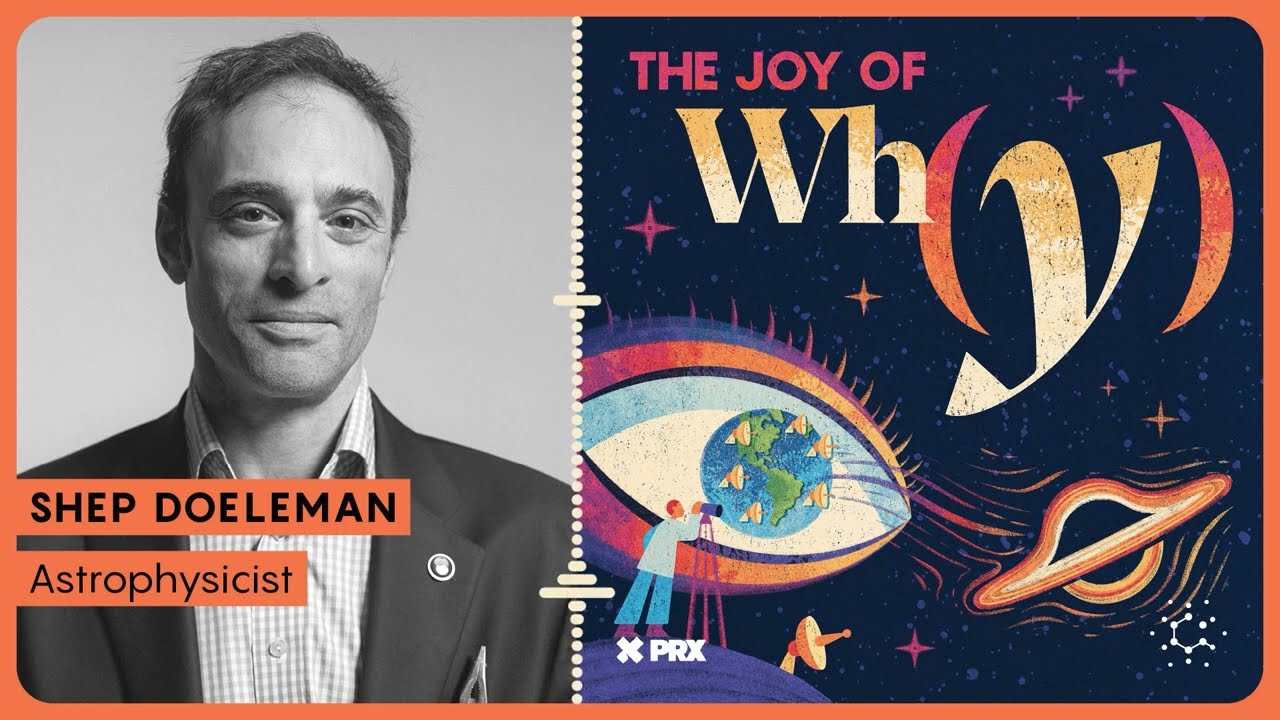
Astrophysicist Shep Doeleman explains how capturing the first image of a black hole required a telescope the size of the world, and why the next goal is to create a movie.
“The Joy of Why” is a Quanta Magazine podcast about curiosity and the pursuit of knowledge. The mathematician and author Steven Strogatz and the cosmologist and author Janna Levin take turns interviewing leading researchers about the great scientific and mathematical questions of our time. For more episodes visit Quanta Magazine: https://www.quantamagazine.org/tag/the-joy-of-why/
--------
00:00 Why black holes fascinate us
03:27 Meet Shep Doeleman
06:44 How we knew black holes existed
11:28 Turning Earth into a telescope
19:24 Building the Event Horizon Telescope
26:19 M87 vs. Sagittarius A*
35:06 Revealing the first black hole image
39:10 Why black holes look like rings
42:55 Making movies of black holes
46:25 What black hole movies could reveal
49:28 Testing alternatives to black holes
53:12 The joy of seeing the invisible
---------
Black holes are one of the universe’s most exotic and elusive objects. When nothing, not even light, can escape their powerful gravitational grasp, taking a picture of one seems unimaginable. But an image of a black hole, or more accurately its shadow, could offer insights that theory alone may not provide when testing predictions. So how can it be done?
Harvard astrophysicist Shep Doeleman and a team of 250 researchers achieved this extraordinary feat by linking a group of radio telescopes around the world. This network, called the Event Horizon Telescope, produced the first image of a supermassive black hole in the galaxy M87, around 55 million light-years away, and the first image of the black hole at the heart of our galaxy. In this episode, Doeleman tells co-host Janna Levin how he turned the Earth into a telescope capable of seeing a black hole, the incredible level of science and collaboration that was required to achieve this, how the images have furthered our understanding of these exotic objects, and how movies of black holes may be possible by the early 2030s.
---------
"The Joy of Why" is a podcast from Quanta Magazine, an editorially independent publication supported by the Simons Foundation. Funding decisions by the Simons Foundation have no influence on the selection of topics, guests, or other editorial decisions in this podcast or in Quanta Magazine.
"The Joy of Why" is produced by PRX Productions; the production team is Caitlin Faulds, Jade Abdul-Malik, Genevieve Sponsler, and Merritt Jacob. The Executive Producer of PRX Productions is Jocelyn Gonzales. Edwin Ochoa is our project manager. From Quanta Magazine, Simon Frantz and Samir Patel provided editorial guidance, with support from Samuel Velasco, Kit Sudol, Simone Barr, and Michael Kanyongolo. Samir Patel is Quanta’s Editor-in-Chief. The episode art is by Chanelle Nibbelink and our logo is by Jaki King and Kristina Armitage. Special thanks to Garth Avery at the Cornell Broadcast Studio.
---------
Quanta Magazine is an editorially independent publication supported by the Simons Foundation. We focus on developments in mathematics, theoretical physics, theoretical computer science and the basic life sciences.
READ free math and science articles on the Quanta website: www.quantamagazine.org
LEARN about the Simons Foundation: www.simonsfoundation.org
FOLLOW our social channels:
- Instagram: quantamag
- Bluesky: @quantamagazine.bsky.social
- Facebook: quantanews
- X: quantamagazine

Quanta Magazine
Explore mind-bending developments in basic science and math research. Quanta Magazine is an award-winning, editorially independent magazine published by the Simons Foundation. http://www.quantamagazine.org/
For more information, contact quanta@simonsfoun...