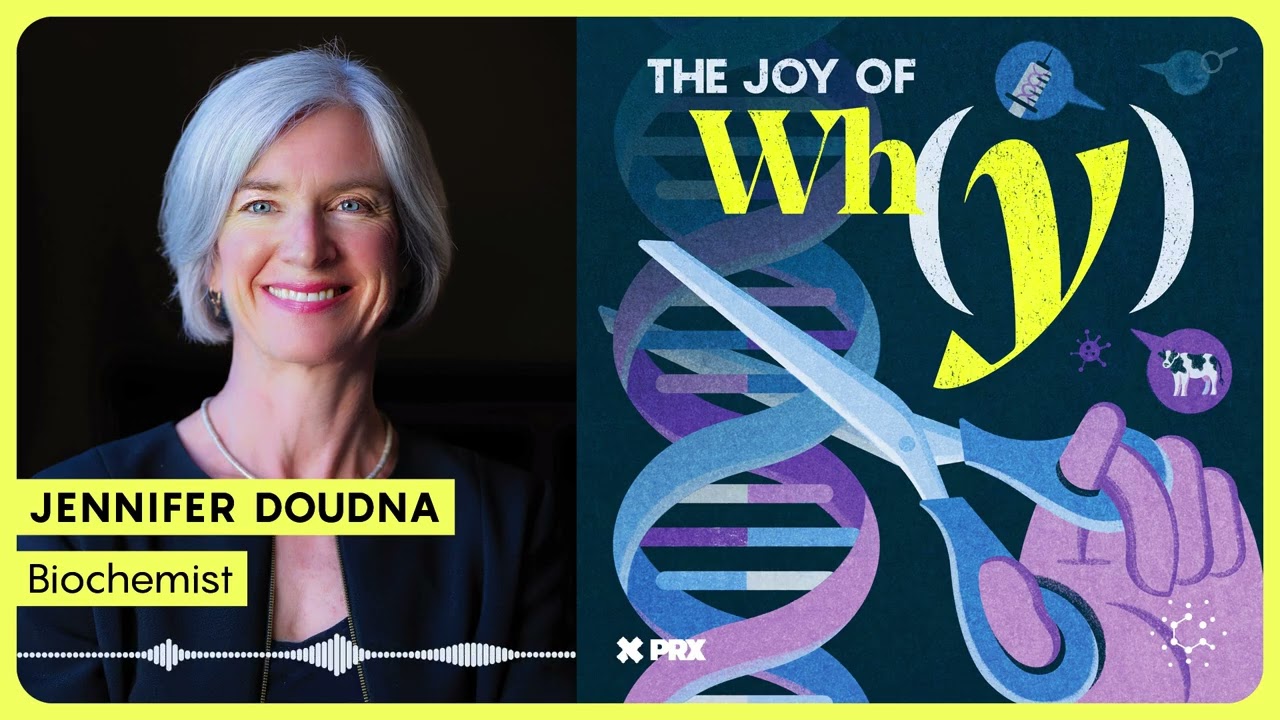
What Is the Future of Gene Editing? | PODCAST: The Joy of Why
Nobel Laureate Jennifer Doudna discusses how she discovered CRISPR’s genome-editing power, the breakthroughs and hurdles during its explosive growth, and what lies ahead for this groundbreaking technology.
“The Joy of Why” is a Quanta Magazine podcast about curiosity and the pursuit of knowledge. The mathematician and author Steven Strogatz and the cosmologist and author Janna Levin take turns interviewing leading researchers about the great scientific and mathematical questions of our time. For more episodes visit Quanta Magazine: https://www.quantamagazine.org/tag/the-joy-of-why/
---------
00:00 Intro: What is CRISPR?
02:37 Meet Jennifer Doudna
05:50 Why Doudna chose RNA over DNA
09:39 Did RNA come before DNA?
10:44 How RNA research led to CRISPR
13:00 What CRISPR Cas9 actually does
17:45 From bacterial immunity to gene editing
19:56 Why the discovery of CRISPR changed everything
24:27 Steve & Janna break down the science
28:14 CRISPR Moves from lab to clinic: Baby KJ
31:52 The most promising genetic therapies
33:40 The biggest challenge: delivery
36:09 Risks, side effects & genetic complexity
38:05 Germline editing and ethics
41:52 CRISPR, climate & food security
43:14 The future of Doudna's research
46:57 Outro: why curiosity-driven science matters
---------
FULL EPISODE DESCRIPTION
One of the most surprising and remarkable discoveries in recent scientific history has been CRISPR. Short for Clustered Regularly Interspaced Short Palindromic Repeats, CRISPR is a form of immune system that evolved in bacteria more than a billion years ago to defend against persistent viral threats. Under attack, bacteria can snip a small fragment of a virus’s DNA, store it in the CRISPR region of their genome, and then use it to recognize and destroy the same virus if it returns. The CRISPR-Cas9 system, to give it its longer name, consists of a short strand of guide RNA that identifies where to cut the DNA and a protein that acts as the molecular scissors.
What made this system truly revolutionary was the demonstration in 2012 that it could be reprogrammed with different pieces of guide RNA to edit virtually any genome in any species, and at a level of precision and ease that far surpassed existing gene-editing tools. Since then, the editing capability of CRISPR has been tested on everything from developing disease treatments to engineering drought-resistant crops to resurrecting genes of extinct species. The possibilities have expanded so rapidly that researchers, ethicists, and regulators have found themselves struggling to keep up.
One person acutely aware of the power of CRISPR is Jennifer Doudna, co-developer of the technology. Doudna, who received the Nobel Prize in Chemistry in 2020 with Emmanuelle Charpentier for this pioneering work, has been a prominent voice not only for its vast potential but also for its responsible and ethical use. In this episode of The Joy of Why, Doudna tells co-host Janna Levin how her early, “rebellious,” decision to study RNA led her on a serendipitous path to one of biology’s most transformative discoveries. They also discuss the breakthroughs, barriers, and frontiers that will define CRISPR’s true impact.
---------
"The Joy of Why" is produced by PRX Productions; the production team is Caitlin Faulds, Jade Abdul-Malik, Genevieve Sponsler, and Merritt Jacob. The Executive Producer of PRX Productions is Jocelyn Gonzales. Edwin Ochoa is our project manager.
From Quanta Magazine, Simon Frantz and Samir Patel provided editorial guidance, with support from Samuel Velasco, Simone Barr, and Michael Kanyongolo. Samir Patel is Quanta’s Editor-in-Chief.
The episode art is by Chanelle Nibbelink and our logo is by Jaki King and Kristina Armitage. Special thanks to Garth Avery at the Cornell Broadcast Studio.
I’m your host, Janna Levin. If you have any questions or comments, please email us at quanta@simonsfoundation.org. Thanks for listening!
---------
Quanta Magazine, an editorially independent publication supported by the Simons Foundation. Funding decisions by the Simons Foundation have no influence on the selection of topics, guests or other editorial decisions in this podcast or in Quanta Magazine.
READ free math and science articles on the Quanta website: https://www.quantamagazine.org
LEARN about the Simons Foundation: www.simonsfoundation.org
FOLLOW our social channels:
- Instagram: quantamag
- Bluesky: @quantamagazine.bsky.social
- Facebook: quantanews
- X: quantamagazine
“The Joy of Why” is a Quanta Magazine podcast about curiosity and the pursuit of knowledge. The mathematician and author Steven Strogatz and the cosmologist and author Janna Levin take turns interviewing leading researchers about the great scientific and mathematical questions of our time. For more episodes visit Quanta Magazine: https://www.quantamagazine.org/tag/the-joy-of-why/
---------
00:00 Intro: What is CRISPR?
02:37 Meet Jennifer Doudna
05:50 Why Doudna chose RNA over DNA
09:39 Did RNA come before DNA?
10:44 How RNA research led to CRISPR
13:00 What CRISPR Cas9 actually does
17:45 From bacterial immunity to gene editing
19:56 Why the discovery of CRISPR changed everything
24:27 Steve & Janna break down the science
28:14 CRISPR Moves from lab to clinic: Baby KJ
31:52 The most promising genetic therapies
33:40 The biggest challenge: delivery
36:09 Risks, side effects & genetic complexity
38:05 Germline editing and ethics
41:52 CRISPR, climate & food security
43:14 The future of Doudna's research
46:57 Outro: why curiosity-driven science matters
---------
FULL EPISODE DESCRIPTION
One of the most surprising and remarkable discoveries in recent scientific history has been CRISPR. Short for Clustered Regularly Interspaced Short Palindromic Repeats, CRISPR is a form of immune system that evolved in bacteria more than a billion years ago to defend against persistent viral threats. Under attack, bacteria can snip a small fragment of a virus’s DNA, store it in the CRISPR region of their genome, and then use it to recognize and destroy the same virus if it returns. The CRISPR-Cas9 system, to give it its longer name, consists of a short strand of guide RNA that identifies where to cut the DNA and a protein that acts as the molecular scissors.
What made this system truly revolutionary was the demonstration in 2012 that it could be reprogrammed with different pieces of guide RNA to edit virtually any genome in any species, and at a level of precision and ease that far surpassed existing gene-editing tools. Since then, the editing capability of CRISPR has been tested on everything from developing disease treatments to engineering drought-resistant crops to resurrecting genes of extinct species. The possibilities have expanded so rapidly that researchers, ethicists, and regulators have found themselves struggling to keep up.
One person acutely aware of the power of CRISPR is Jennifer Doudna, co-developer of the technology. Doudna, who received the Nobel Prize in Chemistry in 2020 with Emmanuelle Charpentier for this pioneering work, has been a prominent voice not only for its vast potential but also for its responsible and ethical use. In this episode of The Joy of Why, Doudna tells co-host Janna Levin how her early, “rebellious,” decision to study RNA led her on a serendipitous path to one of biology’s most transformative discoveries. They also discuss the breakthroughs, barriers, and frontiers that will define CRISPR’s true impact.
---------
"The Joy of Why" is produced by PRX Productions; the production team is Caitlin Faulds, Jade Abdul-Malik, Genevieve Sponsler, and Merritt Jacob. The Executive Producer of PRX Productions is Jocelyn Gonzales. Edwin Ochoa is our project manager.
From Quanta Magazine, Simon Frantz and Samir Patel provided editorial guidance, with support from Samuel Velasco, Simone Barr, and Michael Kanyongolo. Samir Patel is Quanta’s Editor-in-Chief.
The episode art is by Chanelle Nibbelink and our logo is by Jaki King and Kristina Armitage. Special thanks to Garth Avery at the Cornell Broadcast Studio.
I’m your host, Janna Levin. If you have any questions or comments, please email us at quanta@simonsfoundation.org. Thanks for listening!
---------
Quanta Magazine, an editorially independent publication supported by the Simons Foundation. Funding decisions by the Simons Foundation have no influence on the selection of topics, guests or other editorial decisions in this podcast or in Quanta Magazine.
READ free math and science articles on the Quanta website: https://www.quantamagazine.org
LEARN about the Simons Foundation: www.simonsfoundation.org
FOLLOW our social channels:
- Instagram: quantamag
- Bluesky: @quantamagazine.bsky.social
- Facebook: quantanews
- X: quantamagazine

Quanta Magazine
Explore mind-bending developments in basic science and math research. Quanta Magazine is an award-winning, editorially independent magazine published by the Simons Foundation. http://www.quantamagazine.org/
For more information, contact quanta@simonsfoun...