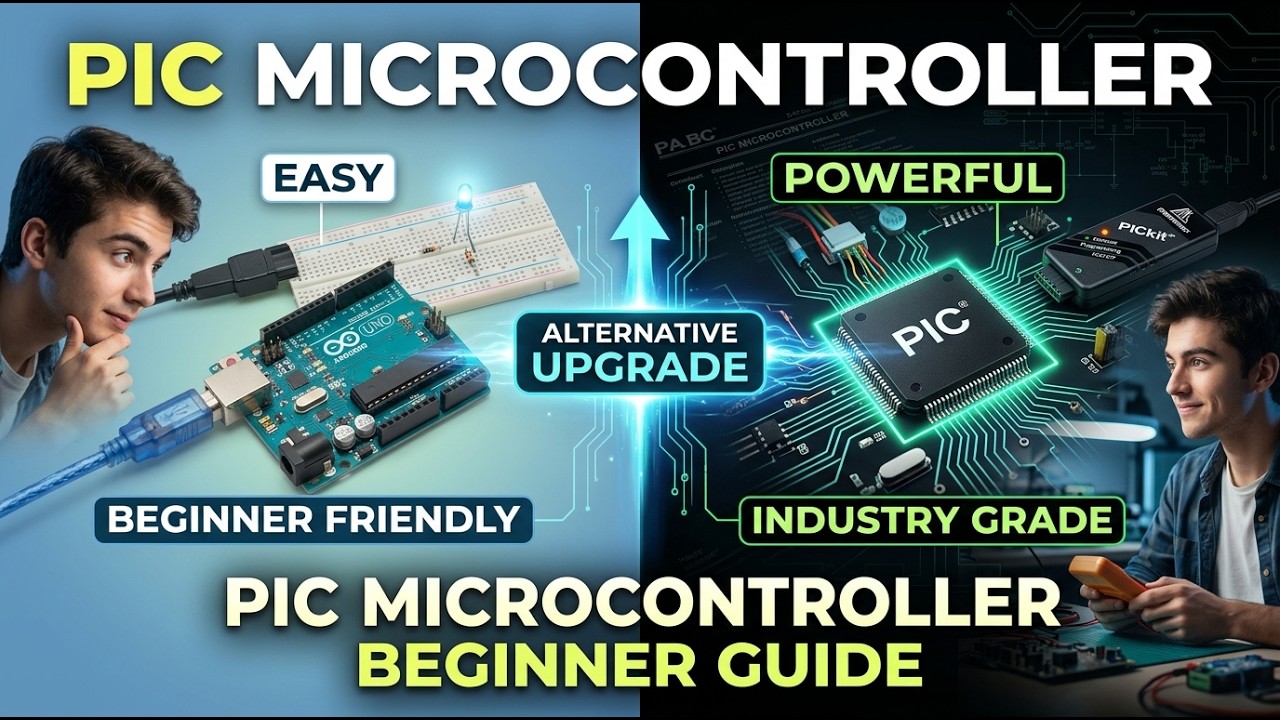
Pinguino PIC Microcontroller Arduino Alternative | Full Beginner Guide | PIC Microcontroller Basics
? Stay Connected:
? Subscribe Now & Start Your Web Development Journey Today!
? [https://www.youtube.com/channel/UCqLYJkKUl5WqdlsoU_5Q9IQ]
Like Facebook page for more Like Facebook page for more update and Videos :https://www.facebook.com/TheTechNerdBD/
Pinguino PIC Microcontroller Arduino Alternative | Full Beginner Guide | PIC Microcontroller Basics
Welcome to this complete beginner-friendly guide on Pinguino PIC Microcontroller Arduino Alternative | Full Beginner Guide | PIC Microcontroller Basics, where you will learn how to work with PIC microcontrollers using the Pinguino platform and understand how it serves as an alternative to Arduino for embedded systems development.
If you are interested in electronics, embedded systems, robotics, or hardware programming, this tutorial will help you take your first step into the world of microcontrollers. The Pinguino platform allows you to program PIC microcontrollers in a way that feels similar to Arduino, making it easier for beginners to transition into advanced embedded systems development.
In this course, we start from the very basics so that even if you have no prior experience with microcontrollers, you can still follow along and build a strong foundation. The goal of this tutorial is to help you understand how PIC microcontrollers work and how Pinguino simplifies the development process.
We begin by introducing what a microcontroller is and how it differs from a microprocessor. You will learn how microcontrollers are used in real-world applications such as home automation, robotics, automotive systems, and industrial control systems. Understanding this foundation is essential before moving into practical programming.
Next, we explore the PIC microcontroller architecture. PIC microcontrollers are widely used in embedded systems due to their efficiency, low power consumption, and reliability. You will learn about their internal structure, input/output pins, memory organization, and how they interact with external components.
After understanding the basics of PIC microcontrollers, we move into the Pinguino platform. Pinguino is an open-source development environment designed to make PIC microcontroller programming easier. It allows you to write code in a simplified way similar to Arduino, which makes it ideal for beginners who want to work with PIC hardware.
One of the main advantages of Pinguino is that it bridges the gap between Arduino-style programming and professional embedded systems development. You do not need to struggle with complex low-level programming at the beginning. Instead, you can focus on learning logic, hardware interaction, and project development.
In this tutorial, you will learn how to set up the Pinguino environment and prepare your system for programming PIC microcontrollers. Proper setup is very important because it ensures smooth development and avoids common errors that beginners often face.
We also cover how to write your first basic program using Pinguino. You will learn how to control input and output pins, blink LEDs, and interact with simple electronic components. These basic exercises are essential for understanding how microcontrollers communicate with the physical world.
As you progress, you will learn how to use digital inputs and outputs effectively. This includes working with buttons, sensors, and other input devices. You will understand how microcontrollers read signals and respond to them in real time.
We also explore timing functions and delays, which are important in embedded systems programming. You will learn how to control timing in your projects and create accurate delays for different applications.
Another important topic covered in this tutorial is analog input and output. You will learn how to read analog signals from sensors and convert them into digital values that the microcontroller can process. This is essential for working with real-world data such as temperature, light, and distance sensors.
? Subscribe Now & Start Your Web Development Journey Today!
? [https://www.youtube.com/channel/UCqLYJkKUl5WqdlsoU_5Q9IQ]
Like Facebook page for more Like Facebook page for more update and Videos :https://www.facebook.com/TheTechNerdBD/
Pinguino PIC Microcontroller Arduino Alternative | Full Beginner Guide | PIC Microcontroller Basics
Welcome to this complete beginner-friendly guide on Pinguino PIC Microcontroller Arduino Alternative | Full Beginner Guide | PIC Microcontroller Basics, where you will learn how to work with PIC microcontrollers using the Pinguino platform and understand how it serves as an alternative to Arduino for embedded systems development.
If you are interested in electronics, embedded systems, robotics, or hardware programming, this tutorial will help you take your first step into the world of microcontrollers. The Pinguino platform allows you to program PIC microcontrollers in a way that feels similar to Arduino, making it easier for beginners to transition into advanced embedded systems development.
In this course, we start from the very basics so that even if you have no prior experience with microcontrollers, you can still follow along and build a strong foundation. The goal of this tutorial is to help you understand how PIC microcontrollers work and how Pinguino simplifies the development process.
We begin by introducing what a microcontroller is and how it differs from a microprocessor. You will learn how microcontrollers are used in real-world applications such as home automation, robotics, automotive systems, and industrial control systems. Understanding this foundation is essential before moving into practical programming.
Next, we explore the PIC microcontroller architecture. PIC microcontrollers are widely used in embedded systems due to their efficiency, low power consumption, and reliability. You will learn about their internal structure, input/output pins, memory organization, and how they interact with external components.
After understanding the basics of PIC microcontrollers, we move into the Pinguino platform. Pinguino is an open-source development environment designed to make PIC microcontroller programming easier. It allows you to write code in a simplified way similar to Arduino, which makes it ideal for beginners who want to work with PIC hardware.
One of the main advantages of Pinguino is that it bridges the gap between Arduino-style programming and professional embedded systems development. You do not need to struggle with complex low-level programming at the beginning. Instead, you can focus on learning logic, hardware interaction, and project development.
In this tutorial, you will learn how to set up the Pinguino environment and prepare your system for programming PIC microcontrollers. Proper setup is very important because it ensures smooth development and avoids common errors that beginners often face.
We also cover how to write your first basic program using Pinguino. You will learn how to control input and output pins, blink LEDs, and interact with simple electronic components. These basic exercises are essential for understanding how microcontrollers communicate with the physical world.
As you progress, you will learn how to use digital inputs and outputs effectively. This includes working with buttons, sensors, and other input devices. You will understand how microcontrollers read signals and respond to them in real time.
We also explore timing functions and delays, which are important in embedded systems programming. You will learn how to control timing in your projects and create accurate delays for different applications.
Another important topic covered in this tutorial is analog input and output. You will learn how to read analog signals from sensors and convert them into digital values that the microcontroller can process. This is essential for working with real-world data such as temperature, light, and distance sensors.

Full Course
This channel is about full courses any type of Content Software So Subscribe For Upcoming New Fully Free Course By Full course....
How to save Your file in Claude storage and use it later #shorts #vairalshorts #tutorial
Full Course
10 Proven Sales Models to Skyrocket Your Business Growth in 2026 | Increase Revenue Fast
Full Course