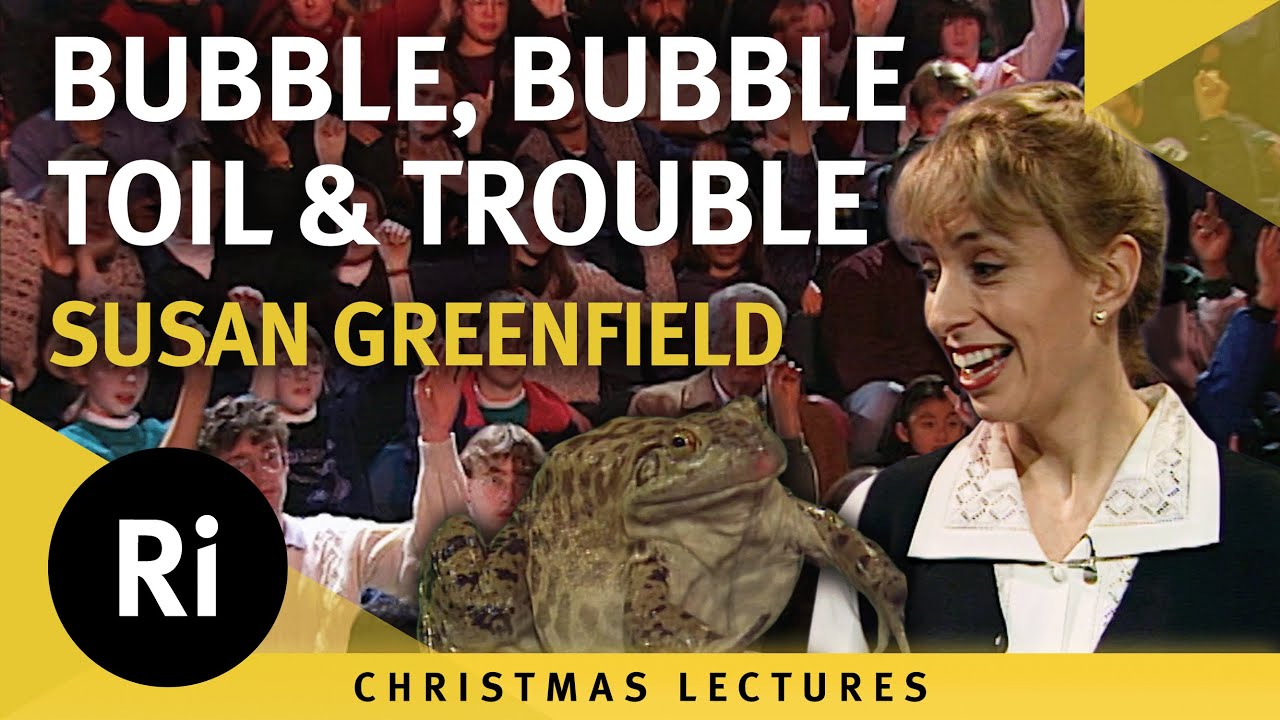
Bubble, Bubble, Toil and Trouble - Susan Greenfield's 1994 Christmas Lectures 3/5
In her third lecture, Dr Susan Greenfield asks if the brain works like a computer, or a bubbling cauldron of chemicals, and considers how nerve signals actually work.
Watch all the lectures in this series here: https://www.youtube.com/playlist?list=PLbnrZHfNEDZxB8thM5bFRFwY5BVIBtM_O
Watch our newest Christmas lectures here: https://www.youtube.com/playlist?list=PLbnrZHfNEDZyQJZLPMjwEoOLdkFBLU2m1
This lecture was filmed at the Ri on Thursday 22nd December 1994.
--
This year marks 200 years of the Royal Institution Christmas Lectures — a world famous series showcasing science, curiosity, and mind-blowing demos, and started by the legendary Michael Faraday himself. To celebrate, we're unlocking the archive. We're uploading all the classic lectures to our YouTube channel — some not seen since they aired on TV. Sign up as a Science Supporter and get early access here: https://www.youtube.com/channel/UCYeF244yNGuFefuFKqxIAXw/join
--
If the brain were pulled apart until we arrived at its most basic component, we would finally come to the brain cell, or neuron. One of the readiest ways of studying brain cells at work is to see how they respond to identified events in the outside world, such as a sight or a sound. Cells in the human retina convert the physical properties of a visual image into nerve signals. From the retina inwards
into the brain, separate relays of neurons process in parallel different aspects of that image, such as its shape, colour and movement. However, it is still a mystery how the whole visual picture is recognised as a cohesive pattern. But what really happens when a neuron 'responds' to a signal from another cell? When a neuron needs to pass on a specific signal, it generates an 'action potential'. Action potentials are usually very short, some one to two milliseconds in duration. For this brief period, the ions in the brain, most basically sodium and potassium, redistribute themselves across the membrane wall of the neuron to cause a sharp change in potential difference. This potential difference is then propagated down the length of the neuron to where it reaches out to the next cell. Once the end of the neuron is activated by the action potential, it
releases a chemical messenger, a 'transmitter'. This transmitter diffuses to the next cell and binds to it on special target proteins. Once the transmitter binds to the protein, ion channels in the second cell will open, so causing a change once again in the potential difference. In this way neurons communicate by an electrical signal encoded by the first cell into a chemical one, which is decoded
back into an electrical signal by the second cell. A wide variety of drugs can interfere with this process and consequently change dramatically how we think and feel.
--
Then Dr Susan, now Baroness Greenfield (b.1950), presented the 1994 CHRISTMAS LECTURES as a five-part series, entitled 'Journey to the Centres of the Brain'. Our brains are ourselves. Every emotion, prejudice and hope is grounded in a molecular scenario somehow and somewhere in the secretive, silent organ between the ears. These lectures will explore what we know, and what still mystifies us, about the workings of the brain. Starting with no prior knowledge, we shall see what the brain looks like, how it generates electricity, and how it uses chemicals to process information. We shall be left with the thought that we know a great deal about how different brain regions function, but how such regions work together to generate a cohesive, individual individual consciousness, remains a tantalising puzzle.
--
Join this channel to get access to perks:
https://www.youtube.com/channel/UCYeF244yNGuFefuFKqxIAXw/join
Subscribe for regular science videos: http://bit.ly/RiSubscRibe
The Ri is on Twitter: http://twitter.com/ri_science
and Facebook: http://www.facebook.com/royalinstitution
and TikTok: https://www.tiktok.com/@ri_science
Listen to the Ri podcast: https://podcasters.spotify.com/pod/show/ri-science-podcast
Donate to the RI and help us bring you more lectures: https://www.rigb.org/support-us/donate-ri
Our editorial policy: https://www.rigb.org/editing-ri-talks-and-moderating-comments
Subscribe for the latest science videos: http://bit.ly/RiNewsletter
Product links on this page may be affiliate links which means it won't cost you any extra but we may earn a small commission if you decide to purchase through the link.
Watch all the lectures in this series here: https://www.youtube.com/playlist?list=PLbnrZHfNEDZxB8thM5bFRFwY5BVIBtM_O
Watch our newest Christmas lectures here: https://www.youtube.com/playlist?list=PLbnrZHfNEDZyQJZLPMjwEoOLdkFBLU2m1
This lecture was filmed at the Ri on Thursday 22nd December 1994.
--
This year marks 200 years of the Royal Institution Christmas Lectures — a world famous series showcasing science, curiosity, and mind-blowing demos, and started by the legendary Michael Faraday himself. To celebrate, we're unlocking the archive. We're uploading all the classic lectures to our YouTube channel — some not seen since they aired on TV. Sign up as a Science Supporter and get early access here: https://www.youtube.com/channel/UCYeF244yNGuFefuFKqxIAXw/join
--
If the brain were pulled apart until we arrived at its most basic component, we would finally come to the brain cell, or neuron. One of the readiest ways of studying brain cells at work is to see how they respond to identified events in the outside world, such as a sight or a sound. Cells in the human retina convert the physical properties of a visual image into nerve signals. From the retina inwards
into the brain, separate relays of neurons process in parallel different aspects of that image, such as its shape, colour and movement. However, it is still a mystery how the whole visual picture is recognised as a cohesive pattern. But what really happens when a neuron 'responds' to a signal from another cell? When a neuron needs to pass on a specific signal, it generates an 'action potential'. Action potentials are usually very short, some one to two milliseconds in duration. For this brief period, the ions in the brain, most basically sodium and potassium, redistribute themselves across the membrane wall of the neuron to cause a sharp change in potential difference. This potential difference is then propagated down the length of the neuron to where it reaches out to the next cell. Once the end of the neuron is activated by the action potential, it
releases a chemical messenger, a 'transmitter'. This transmitter diffuses to the next cell and binds to it on special target proteins. Once the transmitter binds to the protein, ion channels in the second cell will open, so causing a change once again in the potential difference. In this way neurons communicate by an electrical signal encoded by the first cell into a chemical one, which is decoded
back into an electrical signal by the second cell. A wide variety of drugs can interfere with this process and consequently change dramatically how we think and feel.
--
Then Dr Susan, now Baroness Greenfield (b.1950), presented the 1994 CHRISTMAS LECTURES as a five-part series, entitled 'Journey to the Centres of the Brain'. Our brains are ourselves. Every emotion, prejudice and hope is grounded in a molecular scenario somehow and somewhere in the secretive, silent organ between the ears. These lectures will explore what we know, and what still mystifies us, about the workings of the brain. Starting with no prior knowledge, we shall see what the brain looks like, how it generates electricity, and how it uses chemicals to process information. We shall be left with the thought that we know a great deal about how different brain regions function, but how such regions work together to generate a cohesive, individual individual consciousness, remains a tantalising puzzle.
--
Join this channel to get access to perks:
https://www.youtube.com/channel/UCYeF244yNGuFefuFKqxIAXw/join
Subscribe for regular science videos: http://bit.ly/RiSubscRibe
The Ri is on Twitter: http://twitter.com/ri_science
and Facebook: http://www.facebook.com/royalinstitution
and TikTok: https://www.tiktok.com/@ri_science
Listen to the Ri podcast: https://podcasters.spotify.com/pod/show/ri-science-podcast
Donate to the RI and help us bring you more lectures: https://www.rigb.org/support-us/donate-ri
Our editorial policy: https://www.rigb.org/editing-ri-talks-and-moderating-comments
Subscribe for the latest science videos: http://bit.ly/RiNewsletter
Product links on this page may be affiliate links which means it won't cost you any extra but we may earn a small commission if you decide to purchase through the link.

The Royal Institution
Videos to make you think more deeply about science. Explosive short films, full length talks from the world’s leading scientists and writers, and videos to challenge the way you look at the world.
The Royal Institution is a 200 year old independent chari...
Science, strings and symphonies – Charles Taylor’s 1989 Christmas Lectures 3/5
The Royal Institution
Did Kathleen Lonsdale deserve a Nobel Prize? Her groundbreaking work explained
The Royal Institution