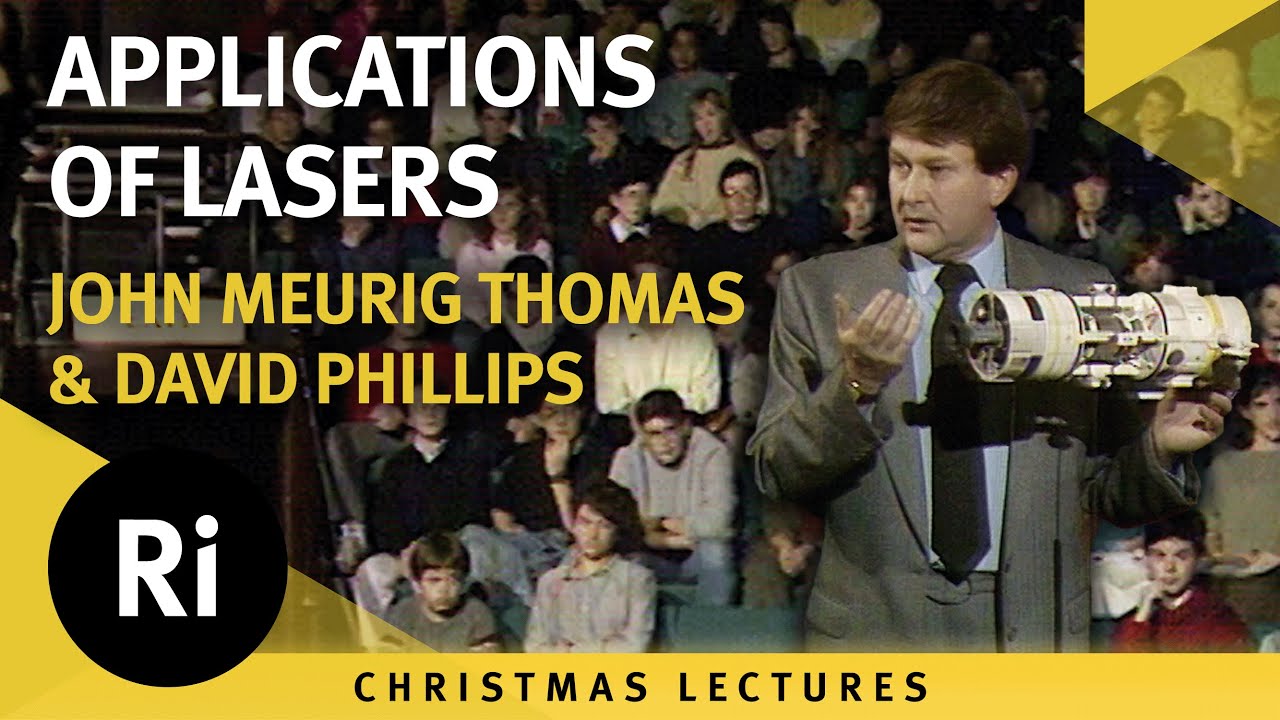
Applications of Lasers - John M. Thomas & David Phillips's 1987 Christmas Lectures 5/6
Lasers are not just for pointing at the board. David Phillips shows us the different applications of laser from their use in research to detecting pollutants in the atmosphere.
Watch all the lectures in this series here: https://www.youtube.com/playlist?list=PLbnrZHfNEDZw7s3y3S1IsaEmka5MWlaq9
Watch our newest Christmas lectures here: https://www.youtube.com/playlist?list=PLbnrZHfNEDZyQJZLPMjwEoOLdkFBLU2m1
This lecture was filmed at the Ri on Thursday 31st December 1987.
--
Pulsed lasers possess the required attributes to enable us to follow the course of chemical events that take place in less than a millionth of a millionth of a second. Moreover, because of its high purity of colour, laser light can be exploited chemically, and medically, selectively to excite atoms that are single isotopes in complex mixtures. This is the basis of powerful methods of separation. The scattering of laser light can also be turned to advantage in measuring the size of molecular entities. Intense pencils of laser light can be used remotely to sense pollutants in the atmosphere. The coherence of laser light gives rise to holography and a display of holograms of widely different types will be presented.
Lasers are used in telecommunications, and we will show the passage of laser light down an exceptionally long fibre without loss of intensity. Advantage is taken of such fibre optics to sense pressure and temperature changes, and to make a laser gyroscope of potential value in inertial navigation.
Lasers, it has to be recognised, also have military applications, and some of these will be outlined.
--
Crystals first appeared on earth many millions of years before the emergence of life. The first laser, however, based on a man-made crystal of ruby, was fashioned less than thirty years ago. Nowadays, crystals and lasers play crucial roles in the design of new materials, in the expanding world of communications, in medicine and environmental science and in the quest for better, cleaner forms of energy. They also function as the picot for a wide range of fundamental scientific studies.
In this series of six CHRISTMAS LECTURES, Professors John Meurig Thomas (1932-2020) and David Phillips (b.1939) explore the science and applications of crystals and lasers, reviving some of the key experiments from the history and evolution of physical sciences and exploring what the future might bring.
--
Join this channel to get access to perks:
https://www.youtube.com/channel/UCYeF244yNGuFefuFKqxIAXw/join
Subscribe for regular science videos: http://bit.ly/RiSubscRibe
The Ri is on Twitter: http://twitter.com/ri_science
and Facebook: http://www.facebook.com/royalinstitution
and TikTok: https://www.tiktok.com/@ri_science
Listen to the Ri podcast: https://podcasters.spotify.com/pod/show/ri-science-podcast
Donate to the RI and help us bring you more lectures: https://www.rigb.org/support-us/donate-ri
Our editorial policy: https://www.rigb.org/editing-ri-talks-and-moderating-comments
Subscribe for the latest science videos: http://bit.ly/RiNewsletter
Product links on this page may be affiliate links which means it won't cost you any extra but we may earn a small commission if you decide to purchase through the link.
Watch all the lectures in this series here: https://www.youtube.com/playlist?list=PLbnrZHfNEDZw7s3y3S1IsaEmka5MWlaq9
Watch our newest Christmas lectures here: https://www.youtube.com/playlist?list=PLbnrZHfNEDZyQJZLPMjwEoOLdkFBLU2m1
This lecture was filmed at the Ri on Thursday 31st December 1987.
--
Pulsed lasers possess the required attributes to enable us to follow the course of chemical events that take place in less than a millionth of a millionth of a second. Moreover, because of its high purity of colour, laser light can be exploited chemically, and medically, selectively to excite atoms that are single isotopes in complex mixtures. This is the basis of powerful methods of separation. The scattering of laser light can also be turned to advantage in measuring the size of molecular entities. Intense pencils of laser light can be used remotely to sense pollutants in the atmosphere. The coherence of laser light gives rise to holography and a display of holograms of widely different types will be presented.
Lasers are used in telecommunications, and we will show the passage of laser light down an exceptionally long fibre without loss of intensity. Advantage is taken of such fibre optics to sense pressure and temperature changes, and to make a laser gyroscope of potential value in inertial navigation.
Lasers, it has to be recognised, also have military applications, and some of these will be outlined.
--
Crystals first appeared on earth many millions of years before the emergence of life. The first laser, however, based on a man-made crystal of ruby, was fashioned less than thirty years ago. Nowadays, crystals and lasers play crucial roles in the design of new materials, in the expanding world of communications, in medicine and environmental science and in the quest for better, cleaner forms of energy. They also function as the picot for a wide range of fundamental scientific studies.
In this series of six CHRISTMAS LECTURES, Professors John Meurig Thomas (1932-2020) and David Phillips (b.1939) explore the science and applications of crystals and lasers, reviving some of the key experiments from the history and evolution of physical sciences and exploring what the future might bring.
--
Join this channel to get access to perks:
https://www.youtube.com/channel/UCYeF244yNGuFefuFKqxIAXw/join
Subscribe for regular science videos: http://bit.ly/RiSubscRibe
The Ri is on Twitter: http://twitter.com/ri_science
and Facebook: http://www.facebook.com/royalinstitution
and TikTok: https://www.tiktok.com/@ri_science
Listen to the Ri podcast: https://podcasters.spotify.com/pod/show/ri-science-podcast
Donate to the RI and help us bring you more lectures: https://www.rigb.org/support-us/donate-ri
Our editorial policy: https://www.rigb.org/editing-ri-talks-and-moderating-comments
Subscribe for the latest science videos: http://bit.ly/RiNewsletter
Product links on this page may be affiliate links which means it won't cost you any extra but we may earn a small commission if you decide to purchase through the link.

The Royal Institution
Videos to make you think more deeply about science. Explosive short films, full length talks from the world’s leading scientists and writers, and videos to challenge the way you look at the world.
The Royal Institution is a 200 year old independent chari...
Science, strings and symphonies – Charles Taylor’s 1989 Christmas Lectures 3/5
The Royal Institution
Did Kathleen Lonsdale deserve a Nobel Prize? Her groundbreaking work explained
The Royal Institution