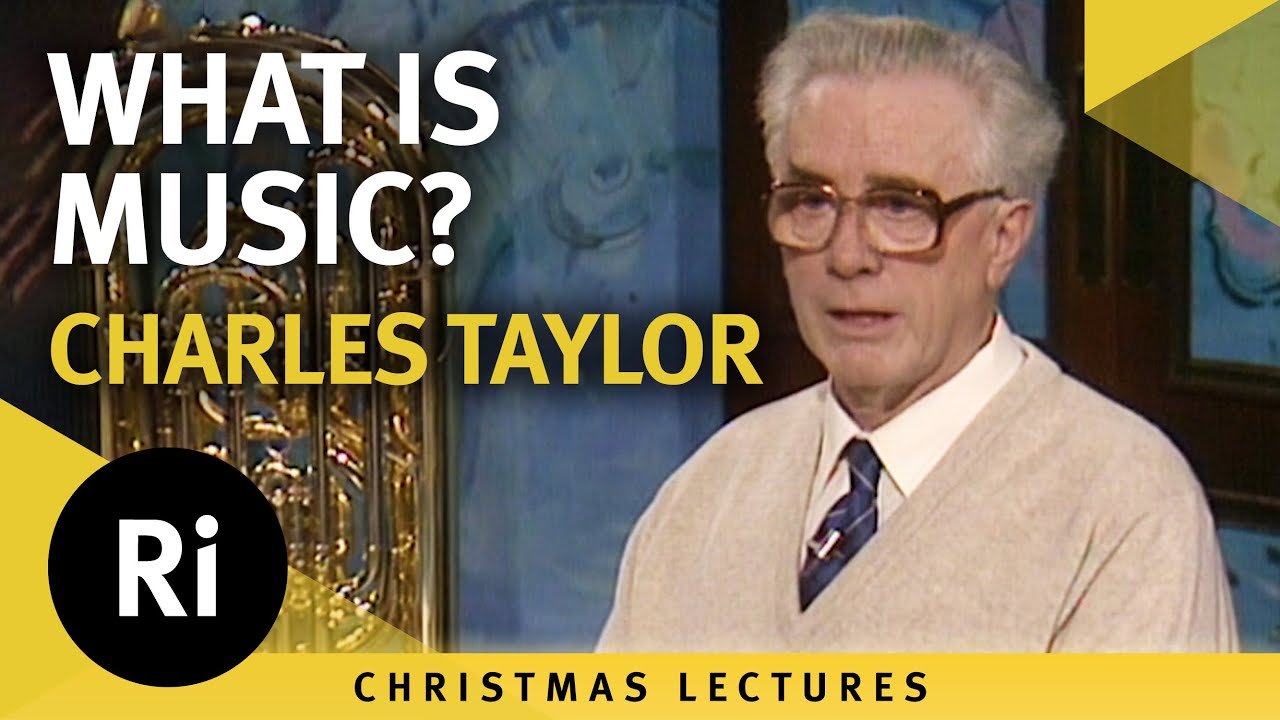
What is music? – Charles Taylor’s 1989 Christmas Lectures 1/5
In his first lecture, Charles Taylor explains why some sounds are musical and others are just noise.
Watch all the lectures in this series here: https://www.youtube.com/playlist?list=PLbnrZHfNEDZywm9-OxvqPpP8RnE4dQnXY
Watch our newest Christmas lectures here: https://www.youtube.com/playlist?list=PLbnrZHfNEDZyQJZLPMjwEoOLdkFBLU2m1
This was recorded on 1 Dec 1989.
--
This year marks 200 years of the Royal Institution Christmas Lectures — a world famous series showcasing science, curiosity, and mind-blowing demos, and started by the legendary Michael Faraday himself. To celebrate, we're unlocking the archive. Every Saturday, we’ll upload a classic lecture to our YouTube channel — some not seen since they aired on TV. Sign up as a Science Supporter and get early access here: https://www.youtube.com/channel/UCYeF244yNGuFefuFKqxIAXw/join
--
From the 1989 programme notes:
Music is one of the most familiar features of everyday life and in all cultures people have always danced and sung in rituals, in celebrations, and as an expression of joy.
Whenever the pressure of the air is changed rapidly, our ear-brain system detects the pressure changes as sound. The sound travels from the source to the listener as sound waves, but what are they really like? And why are some sounds musical and some just noise?
The answer for simple, single sounds is easy: if the vibration is very regular the sound is more musical than if it is irregular. As we move to the more complex sounds and mixtures that occur in the real world of music, the difference is far less easy to describe in any scientific way.
Musical instruments can be used for sending information but is all music concerned with passing on information? Why do some people love music that other people hate? There are obvious differences in musical preferences of people of different cultures, yet some say that music is a universal language. How much of what we like is determined by our experience and how much is from the physics of the ear-brain system? What part does memory and conditioning play in our appreciation of music? Why do some sounds make us laugh and why can music have such a powerful effect on our mood?
It is unlikely that we shall find clear cut answers to these questions, nor to the general question of this lecture. But we should have fun exploring the subject with experiments and recordings and, hopefully, know a little more about music at the end than we did at the beginning.
--
About the 1989 CHRISTMAS LECTURES
Science and music are often treated as separate subjects yet large numbers of scientists are passionate about music. Science is sometimes described as the process of asking questions about the world around us and in this series of lectures, we shall be asking scientific questions about many different aspects of music, starting with the most difficult of all… ‘What is Music?’
It is a fact that every sound is produced by changing the pressure of the air by a small amount. These pressure changes travel as waves to our ears, and when they are perceived by the ear-brain system, they become what we call sound and music. We shall explore the basic science involved in this journey including how musical instruments make pressure changes and the factors that affect sound quality.
The ear-brain system has a profound effect on our perception of music and these lectures will consider this alongside how the technology of instruments in different cultures have influenced the development of music.
These lectures will include demonstrations from over 100 years ago, using much of the original apparatus which has survived at the Royal Institution. While many of the demonstrations in this lecture series may appear to be quite objective, it is necessary to remind ourselves that we are dealing with very subjective phenomena. The experience we call music can on be understood properly if we bring the measurements and observations out of the lab and apply them in the real world of performance and listening.
Find out more about the CHRISTMAS LECTURES here: https://www.rigb.org/christmas-lectures
---
Join this channel to get access to perks:
https://www.youtube.com/channel/UCYeF244yNGuFefuFKqxIAXw/join
Subscribe for regular science videos: http://bit.ly/RiSubscRibe
The Ri is on Twitter: http://twitter.com/ri_science
and Facebook: http://www.facebook.com/royalinstitution
and TikTok: https://www.tiktok.com/@ri_science
Listen to the Ri podcast: https://podcasters.spotify.com/pod/show/ri-science-podcast
Donate to the RI and help us bring you more lectures: https://www.rigb.org/support-us/donate-ri
Our editorial policy: https://www.rigb.org/editing-ri-talks-and-moderating-comments
Subscribe for the latest science videos: http://bit.ly/RiNewsletter
Product links on this page may be affiliate links which means it won't cost you any extra but we may earn a small commission if you decide to purchase through the link.
Watch all the lectures in this series here: https://www.youtube.com/playlist?list=PLbnrZHfNEDZywm9-OxvqPpP8RnE4dQnXY
Watch our newest Christmas lectures here: https://www.youtube.com/playlist?list=PLbnrZHfNEDZyQJZLPMjwEoOLdkFBLU2m1
This was recorded on 1 Dec 1989.
--
This year marks 200 years of the Royal Institution Christmas Lectures — a world famous series showcasing science, curiosity, and mind-blowing demos, and started by the legendary Michael Faraday himself. To celebrate, we're unlocking the archive. Every Saturday, we’ll upload a classic lecture to our YouTube channel — some not seen since they aired on TV. Sign up as a Science Supporter and get early access here: https://www.youtube.com/channel/UCYeF244yNGuFefuFKqxIAXw/join
--
From the 1989 programme notes:
Music is one of the most familiar features of everyday life and in all cultures people have always danced and sung in rituals, in celebrations, and as an expression of joy.
Whenever the pressure of the air is changed rapidly, our ear-brain system detects the pressure changes as sound. The sound travels from the source to the listener as sound waves, but what are they really like? And why are some sounds musical and some just noise?
The answer for simple, single sounds is easy: if the vibration is very regular the sound is more musical than if it is irregular. As we move to the more complex sounds and mixtures that occur in the real world of music, the difference is far less easy to describe in any scientific way.
Musical instruments can be used for sending information but is all music concerned with passing on information? Why do some people love music that other people hate? There are obvious differences in musical preferences of people of different cultures, yet some say that music is a universal language. How much of what we like is determined by our experience and how much is from the physics of the ear-brain system? What part does memory and conditioning play in our appreciation of music? Why do some sounds make us laugh and why can music have such a powerful effect on our mood?
It is unlikely that we shall find clear cut answers to these questions, nor to the general question of this lecture. But we should have fun exploring the subject with experiments and recordings and, hopefully, know a little more about music at the end than we did at the beginning.
--
About the 1989 CHRISTMAS LECTURES
Science and music are often treated as separate subjects yet large numbers of scientists are passionate about music. Science is sometimes described as the process of asking questions about the world around us and in this series of lectures, we shall be asking scientific questions about many different aspects of music, starting with the most difficult of all… ‘What is Music?’
It is a fact that every sound is produced by changing the pressure of the air by a small amount. These pressure changes travel as waves to our ears, and when they are perceived by the ear-brain system, they become what we call sound and music. We shall explore the basic science involved in this journey including how musical instruments make pressure changes and the factors that affect sound quality.
The ear-brain system has a profound effect on our perception of music and these lectures will consider this alongside how the technology of instruments in different cultures have influenced the development of music.
These lectures will include demonstrations from over 100 years ago, using much of the original apparatus which has survived at the Royal Institution. While many of the demonstrations in this lecture series may appear to be quite objective, it is necessary to remind ourselves that we are dealing with very subjective phenomena. The experience we call music can on be understood properly if we bring the measurements and observations out of the lab and apply them in the real world of performance and listening.
Find out more about the CHRISTMAS LECTURES here: https://www.rigb.org/christmas-lectures
---
Join this channel to get access to perks:
https://www.youtube.com/channel/UCYeF244yNGuFefuFKqxIAXw/join
Subscribe for regular science videos: http://bit.ly/RiSubscRibe
The Ri is on Twitter: http://twitter.com/ri_science
and Facebook: http://www.facebook.com/royalinstitution
and TikTok: https://www.tiktok.com/@ri_science
Listen to the Ri podcast: https://podcasters.spotify.com/pod/show/ri-science-podcast
Donate to the RI and help us bring you more lectures: https://www.rigb.org/support-us/donate-ri
Our editorial policy: https://www.rigb.org/editing-ri-talks-and-moderating-comments
Subscribe for the latest science videos: http://bit.ly/RiNewsletter
Product links on this page may be affiliate links which means it won't cost you any extra but we may earn a small commission if you decide to purchase through the link.

The Royal Institution
Videos to make you think more deeply about science. Explosive short films, full length talks from the world’s leading scientists and writers, and videos to challenge the way you look at the world.
The Royal Institution is a 200 year old independent chari...
Science, strings and symphonies – Charles Taylor’s 1989 Christmas Lectures 3/5
The Royal Institution
Did Kathleen Lonsdale deserve a Nobel Prize? Her groundbreaking work explained
The Royal Institution