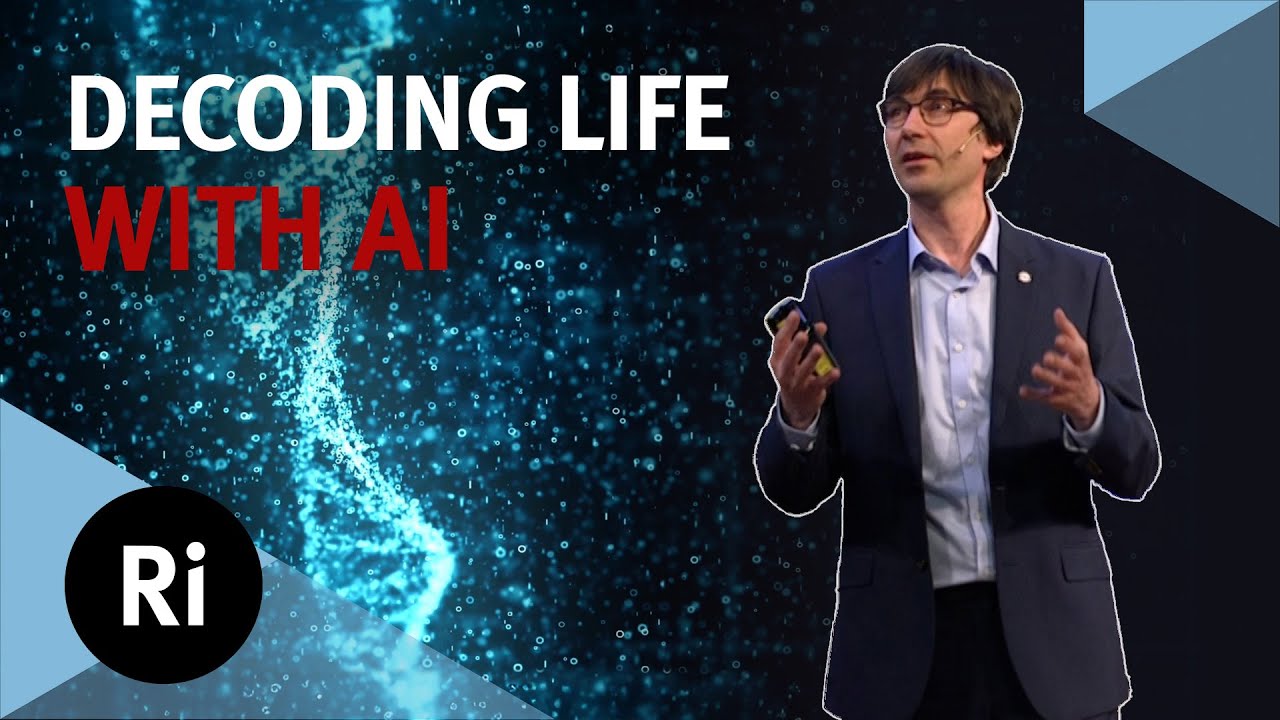
Decoding the secrets of life with AI - with Mikhail Burtsev
Find out how AI is helping to decipher genomes, uncover the secrets of human biology, and accelerate medical discoveries.
This lecture was recorded at the Ri on 7 July 2025, in partnership with the London Institute for Mathematical Sciences.
Join this channel to get access to perks:
https://www.youtube.com/channel/UCYeF244yNGuFefuFKqxIAXw/join
Watch the Q&A here (exclusively for our Science Supporters: https://youtu.be/UL4-vn--ijI
Subscribe for regular science videos: http://bit.ly/RiSubscRibe
Artificial Intelligence is revolutionising our understanding of life. The DeepMind programme tackling the protein folding problem, AlphaFold, earned last year’s Nobel Prize in Chemistry. But that was just the beginning.
Join Mikhail Burtsev for a tour of the leading-edge biological applications of AI, including his own, that are now making complex biological insights more accessible than ever before. AI chatbots such as ChatGPT are trained on human language, but these new AI models are instead fed billions of real DNA sequences, allowing them to perform astonishing feats like designing new biological molecules – or even whole new bacterial genomes. Their ultimate goal is to solve perhaps the most fundamental problem in all of biology – reading and understanding life’s genetic blueprint from beginning to end.
--
Mikhail Burtsev is a Landau AI Fellow at the London Institute for Mathematical Sciences. He studied microelectronics at the Moscow Power Engineering Institute, before doing his PhD in computer science at the Keldysh Institute of Applied Mathematics. He was Scientific Director of the Artificial Intelligence Research Institute in Moscow, and set up and ran the Neural Nets and Deep Learning Laboratory at the Moscow Institute of Physics and Technology. Under his leadership, it developed the award-winning open-source conversational AI framework, DeepPavlov. His research focuses on the mathematics behind more intelligent AI, including continual learning and memory augmented neural networks, as well as AI assisted maths.
--
The Ri is on Twitter: http://twitter.com/ri_science
and Facebook: http://www.facebook.com/royalinstitution
and TikTok: https://www.tiktok.com/@ri_science
Listen to the Ri podcast: https://podcasters.spotify.com/pod/show/ri-science-podcast
Donate to the RI and help us bring you more lectures: https://www.rigb.org/support-us/donate-ri
Our editorial policy: https://www.rigb.org/editing-ri-talks-and-moderating-comments
Subscribe for the latest science videos: http://bit.ly/RiNewsletter
Product links on this page may be affiliate links which means it won't cost you any extra but we may earn a small commission if you decide to purchase through the link.
This lecture was recorded at the Ri on 7 July 2025, in partnership with the London Institute for Mathematical Sciences.
Join this channel to get access to perks:
https://www.youtube.com/channel/UCYeF244yNGuFefuFKqxIAXw/join
Watch the Q&A here (exclusively for our Science Supporters: https://youtu.be/UL4-vn--ijI
Subscribe for regular science videos: http://bit.ly/RiSubscRibe
Artificial Intelligence is revolutionising our understanding of life. The DeepMind programme tackling the protein folding problem, AlphaFold, earned last year’s Nobel Prize in Chemistry. But that was just the beginning.
Join Mikhail Burtsev for a tour of the leading-edge biological applications of AI, including his own, that are now making complex biological insights more accessible than ever before. AI chatbots such as ChatGPT are trained on human language, but these new AI models are instead fed billions of real DNA sequences, allowing them to perform astonishing feats like designing new biological molecules – or even whole new bacterial genomes. Their ultimate goal is to solve perhaps the most fundamental problem in all of biology – reading and understanding life’s genetic blueprint from beginning to end.
--
Mikhail Burtsev is a Landau AI Fellow at the London Institute for Mathematical Sciences. He studied microelectronics at the Moscow Power Engineering Institute, before doing his PhD in computer science at the Keldysh Institute of Applied Mathematics. He was Scientific Director of the Artificial Intelligence Research Institute in Moscow, and set up and ran the Neural Nets and Deep Learning Laboratory at the Moscow Institute of Physics and Technology. Under his leadership, it developed the award-winning open-source conversational AI framework, DeepPavlov. His research focuses on the mathematics behind more intelligent AI, including continual learning and memory augmented neural networks, as well as AI assisted maths.
--
The Ri is on Twitter: http://twitter.com/ri_science
and Facebook: http://www.facebook.com/royalinstitution
and TikTok: https://www.tiktok.com/@ri_science
Listen to the Ri podcast: https://podcasters.spotify.com/pod/show/ri-science-podcast
Donate to the RI and help us bring you more lectures: https://www.rigb.org/support-us/donate-ri
Our editorial policy: https://www.rigb.org/editing-ri-talks-and-moderating-comments
Subscribe for the latest science videos: http://bit.ly/RiNewsletter
Product links on this page may be affiliate links which means it won't cost you any extra but we may earn a small commission if you decide to purchase through the link.

The Royal Institution
Videos to make you think more deeply about science. Explosive short films, full length talks from the world’s leading scientists and writers, and videos to challenge the way you look at the world.
The Royal Institution is a 200 year old independent chari...
Science, strings and symphonies – Charles Taylor’s 1989 Christmas Lectures 3/5
The Royal Institution
Did Kathleen Lonsdale deserve a Nobel Prize? Her groundbreaking work explained
The Royal Institution